
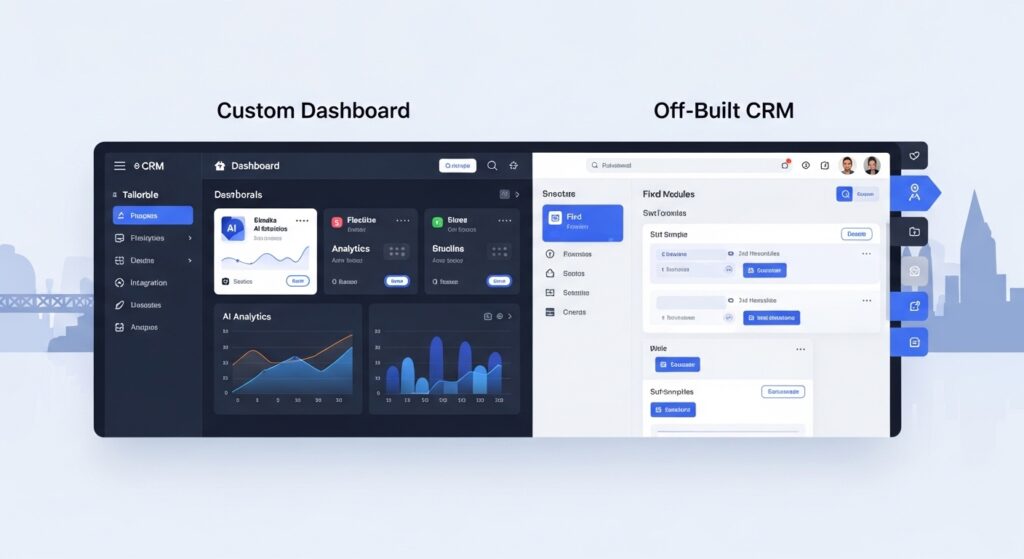
Custom CRM vs Off-the-Shelf CRM is no longer a simple software comparison. For UK businesses preparing for 2026, it is a strategic decision that directly affects scalability, automation, and long-term profitability. As customer data becomes central to competitive advantage, companies must decide whether flexibility or convenience better supports their growth.
Over the past decade, CRM systems have evolved from digital address books into intelligent business engines. Therefore, selecting the right CRM model today will influence operational efficiency for years to come.
The Evolution of CRM in the UK Market
CRM adoption across the UK has accelerated significantly. According to insights from McKinsey & Company, companies that effectively use customer analytics outperform competitors in profitability and retention.
Meanwhile, research from Harvard Business Review highlights that integrated digital systems consistently outperform fragmented technology stacks. As a result, CRM is no longer optional — it is foundational.
Businesses are now evaluating whether standardised systems are enough, or whether a tailored approach is required to remain competitive in 2026.
Understanding Off-the-Shelf CRM
Off-the-shelf CRM platforms are ready-made systems designed for broad business use. Solutions such as Salesforce and HubSpot offer structured workflows, automation tools, and analytics dashboards out of the box.
These platforms are attractive because they provide immediate functionality. However, convenience often comes with structural limitations.
When Off-the-Shelf CRM Works Best
Off-the-shelf solutions are typically suitable when:
-
The business has standard sales processes
-
Rapid deployment is required
-
Budget constraints limit upfront investment
-
Advanced customization is not essential
However, as organisations grow, complexity increases. Consequently, predefined systems may begin to restrict innovation.
Understanding Custom CRM
A custom CRM is designed around your unique operations, sales cycle, reporting requirements, and integration ecosystem. Instead of adjusting your workflow to match software limitations, the software adapts to your strategy.
This distinction is central to the Custom CRM vs Off-the-Shelf CRM debate.
Custom solutions allow businesses to create systems aligned with specific KPIs, customer journeys, and automation goals. Moreover, companies maintain greater control over data architecture and compliance.
Direct Comparison: Custom CRM vs Off-the-Shelf CRM
To simplify decision-making, the table below outlines key strategic differences.
| Factor | Off-the-Shelf CRM | Custom CRM |
|---|---|---|
| Deployment Speed | Fast implementation | Longer development timeline |
| Upfront Cost | Low initial cost | Higher initial investment |
| Long-Term Cost | Recurring subscription fees | No licensing fees |
| Customisation | Limited to platform features | Fully tailored workflows |
| Scalability | Tier-based upgrades | Designed for business growth |
| Integration | API-dependent limitations | Built for seamless integration |
| Data Ownership | Platform-dependent controls | Full business control |
As illustrated, off-the-shelf CRM offers speed and simplicity. In contrast, custom CRM prioritises long-term strategic alignment.
Business Impact in 2026
The CRM landscape in 2026 will revolve around AI, predictive analytics, and automation. According to Statista, global CRM revenue continues to grow steadily, reflecting the rising importance of intelligent customer management.
Impact of Off-the-Shelf CRM
-
Standardised AI features
-
Predefined automation templates
-
Subscription-based scalability
While efficient, these platforms may limit deep operational integration.
Impact of Custom CRM
-
AI models aligned with proprietary datasets
-
Workflow automation designed around internal processes
-
Reporting dashboards tailored to business-specific KPIs
Therefore, businesses aiming for competitive differentiation often lean toward custom solutions.
Cost Analysis: Short-Term Savings vs Long-Term Value
Cost discussions often dominate the Custom CRM vs Off-the-Shelf CRM decision.
Off-the-shelf platforms appear affordable initially. However, cumulative subscription fees, premium upgrades, and per-user charges can escalate over time. For example, expanding teams may face increasing costs annually.
In contrast, custom CRM development requires a larger upfront investment. Nevertheless, there are no recurring licensing fees or user-based scaling charges. Consequently, growing UK businesses may achieve stronger ROI over a five-year horizon.
Implementation Considerations for UK Businesses
Before selecting a CRM model, decision-makers should evaluate several critical factors.
Growth Forecast
If workforce expansion is planned within the next three years, subscription models may become financially restrictive.
Operational Complexity
Businesses with unique workflows or multi-stage approval systems often struggle with rigid platforms.
Regulatory Compliance
UK companies must comply with GDPR. Guidance from Information Commissioner’s Office stresses the importance of secure personal data handling. Custom CRM systems allow enhanced compliance controls and secure architecture planning.
Integration Ecosystem
Modern businesses rely on ERP, marketing automation, accounting software, and AI analytics tools. Therefore, integration capability should be a primary evaluation criterion.
Common Challenges and Best Practices
Regardless of the model chosen, CRM implementation failures often result from poor planning rather than software limitations.
Common Challenges
-
Low user adoption
-
Inadequate training
-
Overcomplicated dashboards
-
Poor data migration strategy
Best Practices
-
Map workflows before development or purchase
-
Involve sales, marketing, and operations teams early
-
Implement phased deployment
-
Prioritise user-centric interface design
Additionally, businesses should align CRM strategy with broader digital transformation goals rather than treating it as an isolated tool.
The Future of CRM Strategy
Looking ahead to 2026 and beyond, CRM systems will integrate more deeply with AI-driven decision-making. Predictive lead scoring, automated pipeline management, and real-time behavioural insights will become standard expectations.
Therefore, adaptability is crucial. In the long term, the Custom CRM vs Off-the-Shelf CRM decision will hinge on whether the system can evolve alongside your digital ecosystem.
Why IQC Solutions® Is the Strategic CRM Partner
Selecting the right CRM approach requires both technical expertise and business foresight. IQC Solutions® delivers integrated digital ecosystems rather than disconnected services.
Through our core digital expertise, we design scalable architectures that align with long-term business growth. Our service portfolio integrates CRM development with web platforms, mobile applications, AI automation, and digital marketing strategies.
What differentiates IQC Solutions® is our unified approach:
-
User-centric system design
-
AI-powered automation capabilities
-
SEO-driven development frameworks
-
Scalable and secure infrastructure
Moreover, we ensure every CRM solution supports measurable business outcomes. If you are evaluating CRM strategy for 2026, our team provides consultation and tailored implementation support through our contact page.
Conclusion: Choosing the Right CRM Path
Ultimately, the Custom CRM vs Off-the-Shelf CRM decision is about alignment, not popularity.
Off-the-shelf systems provide immediate functionality and lower entry costs. However, custom CRM development delivers flexibility, scalability, and competitive advantage over time.
As UK businesses prepare for a more data-driven and AI-powered future, CRM systems will serve as the backbone of revenue operations. Therefore, decision-makers must look beyond short-term savings and prioritise long-term strategic value.
The right CRM choice today will shape operational performance in 2026 and beyond.